From Screen Fatigue to “Slow Tech”: Why Gen Z is Swapping Smartphones for Analog Hobbies
The glow of the smartphone screen was once the ultimate symbol of the future, but for Gen Z, that light is starting to feel a bit too harsh. After a decade of being “always on,” a massive cultural shift is happening. We are witnessing the rise of “Slow Tech”—a movement defined by intentional disconnection. Digital burnout and screen fatigue are no longer just buzzwords; they are physical and mental realities for a generation that grew up with the world in its pocket. From the constant ping of notifications to the endless scroll of doomscrolling habits, the digital native is finally looking for the exit sign.
This transition isn’t just about putting the phone down; it’s about reclaiming the mental space that constant connectivity steals. As students and young professionals face increasing pressure, many are finding that digital minimalism is the key to staying sane. When the pressure of high-stakes projects becomes too much, some look for a reliable Assignment Help Online service like myassignmenthelp to manage their workload, allowing them to step away from the blue light strain and rediscover focus. This balance between utilizing smart digital resources and maintaining a “digital sunset” is becoming the new standard for a healthy, modern lifestyle.
The Anatomy of Digital Burnout
To understand why Gen Z is running toward analog hobbies, we first have to look at the state of the “digital brain” in 2026. Constant connectivity has led to a phenomenon known as “cognitive fragmentation.” This is where the brain is so used to switching between apps, tabs, and notifications that it loses the ability to focus on a single task for more than a few minutes.
| Symptom of Screen Fatigue | Impact on Daily Life | Analog Counter-Measure |
| Blue Light Strain | Disrupts circadian rhythms and causes headaches. | Reading physical books or journals. |
| Phantom Vibration Syndrome | The sensation that your phone is vibrating when it isn’t. | Leaving the phone in a “tech-parking” station. |
| Context Switching | Reduced IQ by up to 10 points due to multitasking. | Single-tasking hobbies like pottery or knitting. |
| Social Comparison | Increased levels of cortisol and anxiety. | Engaging in community-based, offline clubs. |
The Rise of the “Analog Aesthetic”
Walk into any trendy coffee shop or university common room, and you’ll see it: film cameras, paper journals, and vinyl records. This isn’t just nostalgia for a time Gen Z never actually lived through; it’s a craving for tactile feedback. In a world of glass screens, the “click” of a mechanical typewriter or the scratch of a fountain pen on thick paper provides a sensory experience that a haptic motor simply cannot replicate.
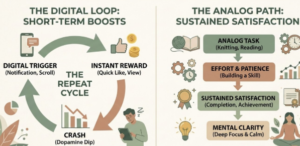
These analog hobbies serve as a “dopamine baseline” reset. When we scroll through social media, our brains are flooded with quick, cheap hits of dopamine that leave us feeling drained. In contrast, knitting a sweater, gardening, or restoring a vintage bike requires “slow dopamine.” It takes time, effort, and patience. This shift toward intentional technology means using devices as tools rather than tethers. By choosing hobbies that don’t require an internet connection, young people are effectively curing their own tech-induced anxiety.
Reclaiming Cognitive Focus through Tactile Learning
The cognitive benefits of going analog are backed by more than just “vibes.” Research suggests that writing by hand and engaging with physical materials improves memory retention and deep work capabilities. When you are staring at thirty open tabs, your brain is in a state of constant “context switching,” which destroys productivity. Analog hobbies train the brain to stay with one task for an extended period, which is a superpower in the modern economy.
For those pursuing complex degrees, the need for deep focus is even more critical. If you are struggling to keep up with intense coursework, seeking Law Assignment Help can be a strategic move to ensure your academic performance doesn’t slip while you are recalibrating your relationship with technology.
The “Slow Tech” Ecosystem (Diagram)
$$\text{Digital Chaos} \rightarrow \text{Screen Fatigue} \rightarrow \text{The Analog Pivot} \rightarrow \text{Restored Focus}$$
- Digital Chaos: High notification frequency, doomscrolling, and blue light exposure.
- Screen Fatigue: Cognitive load increases, leading to burnout and reduced creativity.
- The Analog Pivot: Engaging in hobbies like vinyl collecting, film photography, or physical journaling.
- Restored Focus: Lower cortisol levels, improved deep-work capacity, and better mental health.
Why “Slow Tech” is the Ultimate Career Hack
Contrary to what the “hustle culture” influencers say, being reachable 24/7 doesn’t make you more productive—it just makes you more exhausted. The most successful people in 2026 are those who have mastered the art of the “offline hour.” By stepping back from the Silicon Workforce mentality, Gen Z is actually becoming more creative.
In a professional setting, the ability to sit down and write a comprehensive report or analyze a complex data set without checking a phone every two minutes is becoming a rare and highly valued skill. Analog hobbies act as “cross-training” for the brain. If you can focus on building a complex LEGO set or tending to a vegetable garden for two hours, you can focus on a high-stakes business proposal with the same intensity.
Breaking the Cycle of Doomscrolling
Doomscrolling is a habit designed by algorithms to exploit our survival instincts. It keeps us in a state of “high alert,” which leads to chronic stress. Breaking this cycle requires more than just willpower; it requires a replacement. Every time you feel the urge to check your phone, reach for a book or a sketchpad. This replaces a passive, draining habit with an active, restorative one.
The “Slow Tech” movement also highlights the importance of “Green Computing.” We are becoming more aware of our digital carbon footprint. By spending less time on data-heavy streaming and more time on “off-grid” activities, we are contributing to a more sustainable way of living. It’s a win-win for our mental health and the planet.
The Psychology of “Tactile Joy”
Why does a vinyl record sound better to Gen Z than a high-definition stream? It’s not necessarily about the audio fidelity; it’s about the ritual. Pulling the record from the sleeve, cleaning the dust, and lowering the needle is a deliberate act. It requires you to listen to an album from start to finish, the way the artist intended.
This ritualistic behavior is a direct rebellion against the “skip-culture” of the internet. In a world where everything is available instantly, things that take time feel more valuable. This is why we see a resurgence in handmade crafts, sourdough baking, and even board game cafes. These activities force us into the “here and now,” a state of mindfulness that is nearly impossible to achieve while holding a smartphone.
Strategies for a Sustainable Digital Sunset
If you’re feeling the weight of screen fatigue, you don’t have to throw your smartphone in a river. The “Slow Tech” movement is about boundaries, not total abandonment. Here is how the most successful “analog converts” are building sustainable habits:
- The 8-to-8 Rule: No screens before 8 AM or after 8 PM. This protects your sleep hygiene and your morning mental clarity.
- The Single-Tasking Challenge: Pick one hobby that is impossible to do while looking at a phone (e.g., rock climbing, oil painting, or playing an instrument).
- Physical Archives: Instead of a digital photo dump, print your favorite pictures. Instead of a notes app, keep a physical planner.
- Gray-Scale Mode: Turning your phone screen to black and white makes it significantly less “rewarding” to the brain, reducing the urge to scroll.
The Future is Hybrid: Finding the Middle Ground
As we move further into the 2020s, the “all-or-nothing” approach to technology is fading. We are entering the era of the Hybrid Life. This is where we use high-level AI and digital tools to handle the heavy lifting of our professional and academic lives, leaving our personal time for “analog joy.”
The goal is to be a master of the machine, not a slave to it. Whether it’s through using smart academic resources to free up your schedule or setting strict “no-phone” zones in your home, the power lies in choice. Gen Z isn’t “anti-tech”; they are “pro-human.” They are choosing the smell of old books over the glare of a tablet, and in doing so, they are leading the way toward a more balanced, focused, and fulfilled society.
Final Thoughts: The Power of the Pause
The most sophisticated piece of technology we will ever own is the human brain. Like any high-performance machine, it requires maintenance and downtime. The “Slow Tech” movement isn’t a step backward into the past; it is a leap forward into a more intentional future. By embracing analog hobbies, we aren’t just passing the time—we are protecting our ability to think, create, and connect in an increasingly noisy world.
By embracing the analog, we aren’t moving backward—we are moving inward. We are discovering that the most “advanced” technology on the planet is still the human brain, and it works best when it has the space to breathe, create, and disconnect.
Frequently Asked Questions
What is the main cause of screen fatigue?
Screen fatigue is primarily caused by prolonged exposure to high-energy blue light and the cognitive strain of “context switching.” When the brain constantly jumps between different digital streams, it becomes overstimulated, leading to physical exhaustion and reduced mental focus.
How do analog hobbies help improve mental clarity?
Analog activities require “single-tasking,” which trains the brain to engage in deep concentration. Unlike digital scrolling, which provides instant but fleeting rewards, tactile hobbies like journaling or crafting encourage a slower release of dopamine, helping to reset your attention span and lower stress.
What are some easy ways to start a “digital detox”?
Starting small is the most effective approach. You can implement a “digital sunset” by turning off all electronic devices an hour before bed or designating specific areas of your home, such as the dining table or bedroom, as tech-free zones.
Can I still use technology while embracing “Slow Tech”?
Absolutely. The movement is about intentionality rather than total abandonment. It involves using digital tools as efficient instruments for specific tasks while ensuring they do not intrude upon your personal time or hinder your ability to engage with the physical world.
About The Author:
Min Seow is a dedicated education strategist and lead researcher at MyAssignmentHelp. With a focus on academic integrity and student success, Min explores the evolving landscape of modern learning to provide students with actionable insights for their educational journeys.